The Pavement Lab: One Chalk Line a Week, Four Better Captions a Month

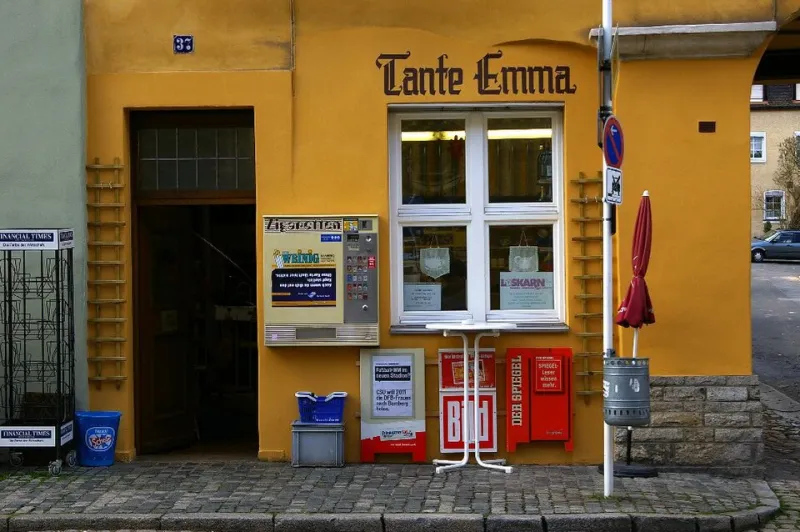
Photo: Michael Garlick , CC BY-SA 2.0, via Wikimedia Commons
There is a certain kind of shop owner who treats the A-board as a legal requirement and nothing more. It goes out at nine, comes in at five, and says ‘OPEN’ in the same handwriting it used last spring. Fair enough. It is doing its job.
But the board is also the only piece of marketing you own that gets seen by people who are not already following you. No algorithm, no reach figures, no comment section. Just a pavement, some passing trade, and whatever you decided to write in chalk that morning.
That makes it an unusually good place to test ideas before you commit them to your feed. One line a week, four lines a month, and by the end you have a small stack of evidence about what actually makes a person stop. Not a survey. Not a vibe. A rough, imperfect, useful signal.
Here is how to run it.
Why the pavement is a fairer test than the feed
Social platforms reward things that have very little to do with your shop: posting at the right time, using the right audio, catching a trend in its first 48 hours. A chalkboard rewards none of that. It rewards clarity, curiosity, and a reason to care. Which, if you think about it, is also what a good caption does.
The board also has a built-in honesty problem. You cannot buy reach. You cannot boost a post. You cannot ask your mum to share it. Either the line stops someone on their way to the bus stop, or it does not.
The four-week rhythm
One prompt per week. That is the whole commitment. Write it on a Monday, leave it up until Friday, and make a note of how it went.
Week one: a question. Something a passer-by could answer in their head in under three seconds. ‘Best biscuit for a brew?’ works. ‘What is the one thing you always forget to buy?’ works better, because it is about them.
Week two: a small, specific offer. Not ‘10% off’. Something with a shape to it: ‘Last six lemon drizzle slices. Name your price after 4pm.’ The specific detail is the test. Does ‘last six’ stop more people than ‘fresh cakes’?
Week three: a statement. A short, opinionated line that sounds like a person, not a poster. ‘We think tea should be stronger than the weather.’ If it gets a smile, you have learned something about your voice.
Week four: the wildcard. A list, a joke, a tiny confession, a hand-drawn map. Something you would never normally put outside. This is the week you find out whether your customers like being surprised.
Reading the pavement without a clipboard
You are not going to stand in the doorway with a tally counter. You have a shop to run.
Instead, use the three signals you already have. First, the glance: did the person slow down, look, and keep walking? Second, the turn: did they actually stop, or step closer? Third, the comment: did anyone mention it at the till? A line that gets quoted back to you is a line that worked.
Keep it simple. A note on your phone, one line per week: what you wrote, roughly how many people you saw stop, and any comment you overheard. Three weeks of that is more useful than a year of guessing.
From chalk to caption
This is the part most people skip. The board is not the point; it is the audition.
If a question gets people talking on the pavement, it will probably get them talking in the comments. Turn it into a caption, a Story poll, or the first line of a Reel. If an offer gets a reaction, that is your next post, with the detail that did the work kept intact.
The losers are useful too. A line nobody looked at is a line you can quietly retire. Better to find that out on a Tuesday morning than after you have spent an hour filming a Reel around it.
Three traps worth avoiding
Testing two things at once. If you change the wording and the placement, you will not know which one did the work. Change one thing a week.
Being too clever. A riddle on a pavement is a puzzle nobody asked for. Clarity beats cleverness almost every time.
Forgetting the shop. The board can be brilliant and the window can be a mess. The line has to match what is behind the door, or it just creates a small disappointment.
The rules of the pavement lab
A few practical notes, because this is a public pavement and not a laboratory.
Chalk needs to be readable from two metres away. Big letters, high contrast, no cursive. If the board is behind a bin or a sandwich board from next door, move it.
Check your council’s rules on A-boards. Most UK high streets have limits on size, placement and how many you can put out. Do not be the shop that gets the whole street told off.
Weather is part of the test. A line that survived a wet Wednesday is a line with staying power. A line that smudged into a grey blur by lunchtime tells you something about your chalk, not your customers.
And keep it kind. No digs at competitors, no politics, nothing that makes a person feel stupid for not understanding the joke. The pavement is a shared space.
What to do on the first of next month
Sit down with your notes. Pick the two lines that got the strongest reaction and turn them into posts. Pick one that surprised you and try a variation. Retire the rest without guilt.
Then write next month’s first question. That is it. Four lines, four weeks, one small habit that makes your feed a little less guessy.
Your A-board has been quietly doing market research for years. This month, start listening to it.